



Choosing a corporate gift supplier can look like a straightforward purchasing task.
You have a budget, a quantity, and probably a deadline. You find a few products, ask for prices, choose the one that looks best, and move on.
That approach works for a simple order.
It becomes much less reliable when the project involves custom packaging, branded products, different recipient groups, personalization, or hundreds of individual deliveries.
At that point, you’re not really buying products anymore.
You’re managing a campaign.
And that’s where choosing the right corporate gift supplier starts to matter.
A supplier needs to do more than provide a catalogue. You need to know whether the products are suitable, whether the quality will hold up across the full order, how branding will be applied, whether samples are available, and who is responsible for assembly and delivery.
The same applies when you’re considering corporate gift baskets or promotional gift products.
A product can look perfect in a catalogue and still be the wrong choice once you consider the recipient, quantity, budget, branding, and practical use.
So before asking, “Which supplier has the best gifts?”, ask something more useful:
Which supplier can actually deliver the experience we want?
What Does a Corporate Gift Supplier Actually Do?
The word “supplier” can mean different things.
Some suppliers mainly provide products in bulk.
Others can take care of branding and packaging as well.
Then there are providers that can manage a much larger part of the process, including:
- Product sourcing.
- Concept development.
- Custom packaging.
- Branding.
- Personalisation.
- Assembly.
- Kitting.
- Quality control.
- Warehousing.
- Fulfilment.
- Delivery.
That difference matters.
If you need 500 identical branded notebooks for a conference, a product-focused supplier may be enough.
If you need 200 customised boxes for employees, with different names, branded packaging, personalised cards, quality checks, and individual delivery, you need a much more involved process.
A full-service corporate gifting partner can be more useful when several of these steps need to be coordinated under one project.
The right supplier is therefore not necessarily the one with the biggest product catalogue.
It’s the one that can handle the parts of the project you don’t want to manage yourself.
Corporate Gift Supplier vs Product Vendor
The two terms are often used interchangeably.
There is, however, a practical difference.
A product vendor is usually focused on selling products.
A corporate gift supplier can be involved in turning those products into a complete gifting project.
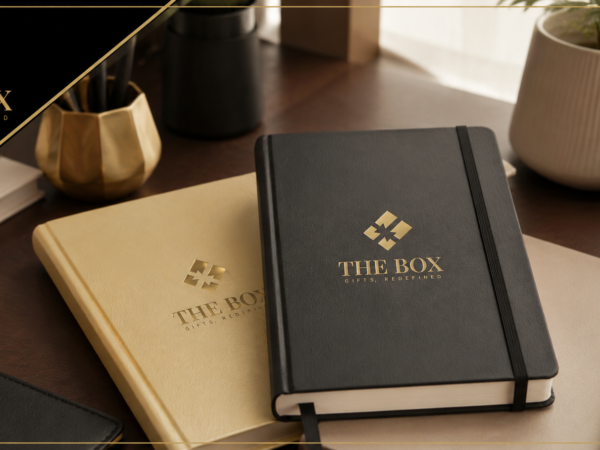
Consider a company ordering 300 branded notebooks.
The vendor may provide the notebooks and print the logo.
A gifting supplier may also help with:
- Selecting the right notebook.
- Choosing packaging.
- Preparing branded inserts.
- Adding personalized cards.
- Organizing assembly.
- Checking the finished units.
- Preparing deliveries.
Neither approach is automatically better.
For a simple promotional order, the first option may be exactly what you need.
For a campaign where the gift itself represents the brand, having one team coordinate several stages can save a considerable amount of internal work.
When Do You Need a Corporate Gift Supplier?
Not every corporate gift requires a specialist.
If you’re ordering a small quantity of identical items, you may be able to manage the process internally.
For example:
- 20 branded notebooks.
- 30 mugs.
- 50 pens.
- Simple event giveaways.
The project becomes more complicated when you introduce more variables.
Large Quantities
The larger the order, the more important consistency becomes.
Custom Packaging
Once the box itself is designed and produced, there are additional production stages to manage.
Personalization
Names, initials, messages, and different recipient tiers all require careful checking.
Multiple Locations
One delivery to a head office is very different from 200 individual deliveries.
Different Recipient Groups
Employees, clients, executives, and VIP partners may all require different products or gifting levels.
This is usually the point where a specialist supplier becomes much more useful than simply purchasing products in bulk.
How to Choose a Corporate Gift Supplier
Before requesting quotations, decide what you expect the supplier to handle.
Then compare providers against the same criteria.
Product Quality
Ask:
- What materials are used?
- Is the product durable?
- Is the quality consistent across large quantities?
- Can I see a sample?
A product that looks good in a catalogue can feel very different when you hold it.
Product Availability
Ask whether the selected products can actually be sourced in the quantity you need.
This is especially important for seasonal campaigns, where popular products can become difficult to source closer to the occasion.
Branding Capability
Find out what the supplier can customize.
This might include:
- Printing.
- Engraving.
- Embossing.
- Custom packaging.
- Inserts.
- Ribbons.
- Sleeves.
- Personalized cards.
The existing brand integration approach from The Box Concept is a useful example of how branding can extend beyond simply placing a logo on a product.
Packaging
Ask whether the supplier can create packaging that:
- Fits the products.
- Protects them.
- Represents the brand.
- Works for the occasion.
- Can survive delivery.
A box that looks beautiful on a presentation table still needs to arrive in good condition.
Fulfilment
Find out who handles:
- Assembly.
- Labelling.
- Quality checks.
- Recipient lists.
- Storage.
- Shipping.
- Delivery.
This becomes particularly important when gifts are being sent to individual recipients.
What Should You Ask Before Approving a Supplier?
You don’t need a complicated questionnaire.
A few practical questions can tell you whether the supplier is equipped for the project.
Ask:
- What is the minimum order quantity?
- Which products are currently available?
- Can I approve a physical sample?
- What branding methods are available?
- Can the packaging be customised?
- Is personalisation available?
- How long does production take?
- Who handles assembly?
- How is quality control managed?
- Can you deliver to multiple locations?
- What happens if a product becomes unavailable?
- What happens if a gift arrives damaged?
- What exactly is included in the quotation?
- How long is the quotation valid?
The answers are often more useful than a beautifully designed sales presentation.
Corporate Gift Baskets: When Are They the Right Choice?
Corporate gift baskets work particularly well when variety is part of the experience.
A basket can feel generous without requiring the rigid structure of a traditional gift box.
They can work well for:
- Seasonal gifting.
- Client appreciation.
- Employee celebrations.
- Gourmet campaigns.
- Hospitality.
- Thank-you gifts.
- Holiday gifting.
Food and beverage products are common choices, but they are not the only option.
A basket might include:
- Coffee.
- Tea.
- Chocolate.
- Cookies.
- Gourmet products.
- Lifestyle products.
- A small keepsake.
The important part is having some connection between the products.
Putting ten unrelated items into a basket does not automatically make the gift more valuable.
A theme usually works better.
Corporate Gift Baskets vs Gift Boxes
The two formats create slightly different experiences.
| Corporate Gift Baskets | Gift Boxes | |
|---|---|---|
| Overall feeling | Generous and varied | Curated and polished |
| Product variety | Usually higher | More controlled |
| Gourmet gifting | Strong fit | Strong fit |
| Seasonal gifting | Strong fit | Strong fit |
| Executive gifting | Depends on contents | Often a stronger fit |
| Custom branding | Flexible | Highly flexible |
| Unboxing | Important | Often central |
| Portability | Depends on size | Easier to standardise |
A basket can be a great choice when the recipient should immediately see a generous selection.
A box can work better when the presentation needs to feel more structured.
Neither is automatically more professional.
The occasion, recipient, and budget should make that decision.
How to Build Better Corporate Gift Baskets
Start with a theme rather than a product list.
Gourmet Basket
A simple combination could include:
- Premium coffee.
- Tea.
- Chocolate.
- Cookies.
- Other suitable gourmet products.
Celebration Basket
You could combine:
- Gourmet treats.
- A small keepsake.
- Personalised card.
- Occasion-specific packaging.
Lifestyle Basket
Consider:
- Beverage products.
- A journal.
- A useful lifestyle accessory.
- A small relaxation item.
The recipient should be part of the decision.
A basket intended for an office team is different from one being sent to a single executive.
The size, product selection, packaging, and even the delivery method may all change.
What Are Promotional Gift Products?
Promotional gift products are branded items that businesses use to increase brand visibility while giving recipients something useful.
They are common at:
- Trade shows.
- Conferences.
- Exhibitions.
- Product launches.
- Marketing activations.
- Corporate events.
- Employee campaigns.
Typical examples include:
- Pens.
- Notebooks.
- Bags.
- Bottles.
- Mugs.
- Phone accessories.
- Desk accessories.
- Technology products.
They are particularly useful when the company needs to reach a relatively large audience.
But promotional products and corporate gifts should not always be treated as the same thing.
Promotional Gift Products vs Corporate Gifts
The same product can sometimes serve either purpose.
Take a notebook.
A company could order 1,000 notebooks with a visible logo and hand them out at an exhibition.
That’s a promotional product.
The same company could send a premium notebook inside a custom box to ten important clients, along with a personalised message.
Now the notebook is part of a corporate gift.
The product didn’t necessarily change.
The audience, presentation, quantity, and purpose did.
| Corporate Gift Baskets | Gift Boxes | |
|---|---|---|
| Overall feeling | Generous and varied | Curated and polished |
| Product variety | Usually higher | More controlled |
| Gourmet gifting | Strong fit | Strong fit |
| Seasonal gifting | Strong fit | Strong fit |
| Executive gifting | Depends on contents | Often a stronger fit |
| Custom branding | Flexible | Highly flexible |
| Unboxing | Important | Often central |
| Portability | Depends on size | Easier to standardise |
Understanding that difference helps prevent companies from spending a premium-gift budget on a campaign that only needs useful event giveaways.
How to Choose Promotional Gift Products
Start with where the product will be used.
Office
Consider:
- Notebooks.
- Pens.
- Desk accessories.
- Drinkware.
Travel
Consider:
- Travel organisers.
- Bottles.
- Charging accessories.
- Bags.
Events
Prioritise:
- Portability.
- Practicality.
- Easy distribution.
- Suitable branding.
Technology
Technology products can attract attention, but compatibility matters.
Before ordering:
- Check compatibility.
- Check product quality.
- Confirm charging standards.
- Test samples where possible.
A promotional product that stops working quickly can leave a worse impression than giving nothing at all.
How Much Branding Should Promotional Products Have?
There isn’t one correct answer.
If the goal is visibility at a public event, stronger branding may be appropriate.
If the product is being given to an executive or important client, excessive branding can make it feel more like advertising than appreciation.
Possible branding points include:
- Small logo.
- Brand colours.
- Custom packaging.
- Branded card.
- Subtle engraving.
- Branded sleeve.
The existing custom corporate gifts content provides more context on how products, packaging, branding, personalisation, and fulfilment can work together.
The branding should support the product.
It shouldn’t overpower it.
How Customization Changes a Corporate Gift
Customization can happen at several levels.
Product-Level Customization
The product itself is branded or modified.
Examples include:
- Printing.
- Engraving.
- Embossing.
- Custom colours.
Packaging-Level Customization
The product remains relatively simple while the packaging carries the brand.
Examples include:
- Custom box.
- Printed sleeve.
- Branded insert.
- Ribbon.
- Tissue.
Recipient-Level Personalisation
The gift is adapted to an individual.
Examples include:
- Name.
- Initials.
- Personal message.
- Client-specific note.
You don’t necessarily need all three.
In fact, adding too much customisation can make a project unnecessarily expensive and difficult to execute.
The best approach is usually the one that adds meaning without creating complexity for its own sake.
Why Samples Matter
A quotation tells you what something is expected to cost.
A sample lets you see what you’re actually getting.
You can check:
- Product quality.
- Material.
- Size.
- Logo placement.
- Color.
- Packaging.
- Product arrangement.
- Personalization.
This matters even more for large orders.
Imagine discovering after 500 boxes have been produced that the logo is too large or the insert doesn’t fit properly.
A sample gives you a chance to fix those issues before they become expensive.
For executive-level campaigns, the existing corporate executive gifts content also highlights the importance of product relevance, material quality, controlled branding, personalisation, and presentation.
What Should a Corporate Gift Supplier Include in the Quote?
A quotation should make the complete cost easy to understand.
Ideally, you should know the cost of:
- Products.
- Branding.
- Packaging.
- Personalisation.
- Sampling.
- Assembly.
- Storage.
- Delivery.
This matters because two suppliers can offer the same products at similar prices and still produce very different final totals.
One supplier may include packaging and assembly.
Another may charge for them separately.
Ask for the complete project cost before comparing the quotes.
Corporate Gift Supplier and Quality Control
Quality control is easy to overlook when you’re focused on the creative idea.
It becomes very important once production starts.
A supplier should have a process for checking:
Products
Are the correct items and quantities being used?
Branding
Is the logo positioned correctly?
Are colors and finishes consistent?
Personalization
Are names and messages accurate?
Packaging
Are the products secure?
Final Kits
Does every finished gift contain everything it should?
One missing item in a 20-unit order is inconvenient.
One missing item in 500 boxes can become a much bigger problem.
That’s why quality control should happen before delivery.
Fulfilment and Delivery
The project isn’t finished when the boxes are assembled.
Someone still needs to make sure they reach the right people.
Before production begins, confirm:
- Full recipient names.
- Addresses.
- Contact numbers.
- Delivery dates.
- Office or home delivery.
- Number of units.
- Special instructions.
This becomes especially important for employee campaigns and client gifts going to multiple locations.
For larger B2B campaigns, B2B gifting provides another useful perspective on planning gifts around the recipient, relationship, occasion, and delivery requirements.
A beautiful gift arriving late, damaged, or at the wrong address is still a failed gifting experience.
One Supplier or Several Vendors?
There are situations where using several vendors makes sense.
One company may have the best notebooks.
Another may offer better packaging.
Another may handle printing.
Another may manage delivery.
But there is a hidden cost:
Your team becomes the project manager.
Someone has to coordinate:
- Timelines.
- Artwork.
- Quantities.
- Samples.
- Quality.
- Packaging.
- Delivery.
For a simple order, that may be manageable.
For a complex campaign, one corporate gift supplier handling multiple stages can reduce that coordination burden.
The choice should therefore depend on the complexity of the project, not simply the number on the quotation.
Corporate Gift Supplier Checklist
Before approving a supplier, confirm:
- Recipient and occasion are clearly defined
- Product quantity is confirmed
- Product availability is verified
- Product quality has been reviewed
- Sample is approved where necessary
- Branding method is agreed
- Packaging is approved
- Personalisation requirements are confirmed
- Recipient information is verified
- Production timeline is realistic
- Quality control is defined
- Assembly is included or clearly priced
- Fulfillment is defined
- Delivery locations are confirmed
- Replacement process is clear
- Complete project cost is understood
- Quote validity is confirmed
Common Mistakes When Choosing a Corporate Gift Supplier
Choosing Based Only on Price
The cheapest quote may exclude packaging, assembly, delivery, or other important services.
Picking Products Before Understanding the Audience
A product that works for employees may not work for executives or clients.
Assuming More Products Mean More Value
A smaller collection of useful products can feel much more premium.
Treating Promotional Products Like Corporate Gifts
The purpose and audience are different.
Skipping the Sample
You cannot always judge material, size, finish, and packaging from a product image.
Overbranding
A gift can be branded without looking like an advertisement.
Leaving Delivery Until the End
Multi-location fulfilment needs planning from the beginning.
Ordering Too Late
Sourcing, artwork, packaging, production, quality control, and delivery all need time.
Conclusion
A good corporate gift supplier should make the project easier, not simply give you more products to choose from.
Start with the recipient.
Then define the occasion and what you want the gift to communicate.
After that, decide which products, packaging, branding, and personalisation make sense.
Corporate gift baskets can work particularly well when variety and a generous presentation are part of the experience. Promotional gift products make more sense when the objective is broad brand visibility at events, exhibitions, or large campaigns.
The important difference is purpose.
A branded pen handed to hundreds of event attendees has one job.
A carefully selected gift sent to an important client has another.
The product may even be similar.
The thinking behind it is not.